
The Last Living Pictographic Script Is Still Written on Handmade Paper
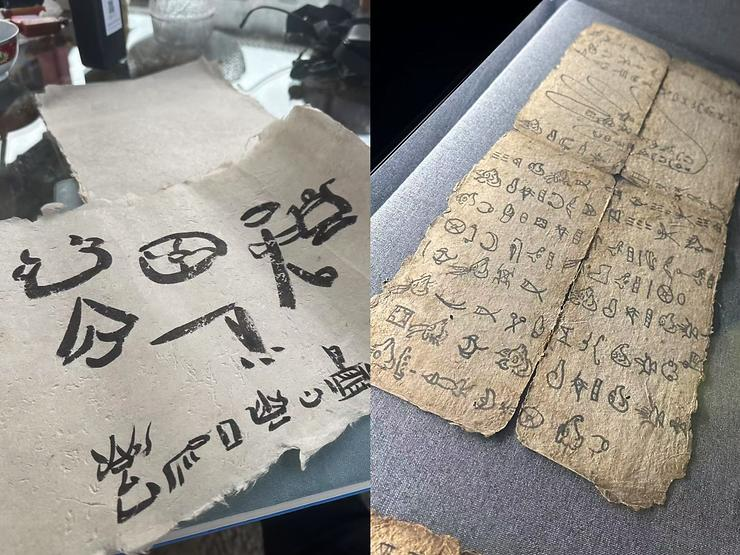
The first time I saw a page of Dongba writing, I did not know where to begin.
Some marks looked like people. Others looked like birds, mountains or tools. My eyes kept trying to turn them into letters, but that was the wrong approach. Dongba script does not look like the writing systems most of us use every day. The page asks you to look before you try to read.
That is what pulled me in.
I work with paper, so I usually notice the sheet first: the fibers, the surface, the way light passes through it. With Dongba manuscripts, the writing and the paper are difficult to separate. One preserves the ideas; the other gives those ideas a physical place to survive.
More Than Pictures on a Page
Dongba script belongs to the Naxi people of southwest China. UNESCO describes it as the world’s last living pictographic script and warns that it is at risk of disappearing because only a small number of people can still use it.
Calling it “picture writing” can make it sound simple. It is not.
UNESCO’s Memory of the World record says the script contains more than 2,000 characters. These pictographs were used to record Naxi customs, religious knowledge and ritual texts. A symbol may begin with the shape of something recognizable, but understanding a manuscript takes more than guessing what each picture resembles. It requires language, memory and cultural context.
That is why a page can look almost familiar while remaining impossible for an outsider to read.
In 2003, the Ancient Naxi Dongba Literature Manuscripts were added to UNESCO’s Memory of the World Register. The manuscripts are valuable because they preserve a large body of Naxi cultural knowledge. UNESCO also makes the danger clear: Dongba culture is being dispersed, few masters can read the texts, and the surviving documents are vulnerable to ageing and repeated handling.
The paper is not magic. It does not make a manuscript indestructible.
But without the paper, there would be no manuscript to protect.
The Paper Under the Words
Traditional Dongba paper is made from local plant fibers, commonly associated with the shrub known in Chinese as raohua. In surviving workshops, the bark is prepared, cooked, beaten into pulp, dispersed in water, formed on a screen, pressed and dried. Official accounts describe dozens of manual steps.
The exact practice can vary from one maker or village to another. That matters. Traditional crafts are often flattened into one neat recipe after they become tourist attractions. Real handwork is messier than that. Tools change. Local materials differ. Knowledge lives in small decisions that may never appear in a written instruction sheet.
What remains consistent is the amount of handling.
The fiber passes through human hands again and again before it becomes a sheet. By the time writing touches the surface, the paper already carries a record of work: bark gathered and cleaned, pulp beaten, water drained, a wet sheet lifted and dried.
As a lamp maker, I understand that part immediately.
Handmade paper never feels like an empty background. Its fibers affect the surface, the strength and the way light moves through it. It has its own presence before anyone writes or paints on it.
Dongba paper makes that presence hard to ignore.
A Living Script Can Still Become Silent
There is a difference between preserving an object and keeping a tradition alive.
A manuscript can be stored in a library. It can be photographed, catalogued and studied. Those things are essential. But a living script also needs people who can read it, teach it and understand the world behind its signs.
UNESCO’s warning is not that every Dongba manuscript will suddenly vanish. The deeper risk is that the connection between the characters and their cultural meaning will grow thinner.
When that happens, the page is still beautiful. The marks are still visible. But more of the voice behind them becomes difficult to hear.
This is why documentation alone is not enough. The craft of making the paper matters. The knowledge of reading the script matters. The communities deciding how both should continue matter most of all.
What This Paper Makes Me Think About
Most of what I write now lives on a screen. It can be copied instantly, searched in seconds and sent across the world. That convenience is real. I would not trade it away.
But handmade paper asks for a different kind of attention.
You notice the limits of the sheet. You think about where a mark will go. You understand that the surface took time to make and cannot be replaced with one click.
Dongba manuscripts take that feeling much further. They remind me that information is never only information. It depends on a material, a reader and a chain of people willing to carry it forward.
That chain can break.
It can also be repaired.
In 2023, UNESCO supported the launch of a multilingual online course introducing Dongba script. Digital tools, often blamed for making cultures look more alike, are also being used to help more people encounter this endangered writing tradition.
I like that tension: an old pictographic script, once written by hand on local paper, now reaching new learners through a screen.
The screen does not replace the paper. The paper does not need to reject the screen. Each can help the other carry something forward.
I still make lamps, not manuscripts. My relationship with Dongba paper begins with touch, texture and light. But learning what has been written on this paper changes the way I handle it.
It is no longer just a beautiful material.
It is part of a living connection between a script, a craft and the people who still know how to read both.
If this story stays with you, search for the Ancient Naxi Dongba Literature Manuscripts and look closely at an actual page. Do not rush to decode it.
Look first.