
I Make Paper Lamps. Here’s What Happens When You Turn Off the Overhead Light.
I remember the first time I held a sheet of handmade paper up to a lamp.
I expected it to feel like paper: thin, flat, easy to overlook. Instead, it felt warm. Not because of the LED behind it. The paper itself seemed to hold a little warmth, as if it still remembered being bark, water and time.
That was a few years ago. I had been working in advertising and video for a long time. My days happened on screens. Most evenings did too.
I started making paper lamps on the side because I needed something my hands could do when my eyes had had enough. There was no grand plan. I wasn’t trying to build a “digital detox” routine. I just wanted to spend part of the evening in a room lit by something softer than glass, metal and a bright ceiling fixture.
That is how I fell into paper.
I’m not a paper historian. I’m a lamp maker. But after handling many kinds of paper, I have learned to notice them with my hands before I judge them with my eyes.
Traditional Xuan paper from Jing County in Anhui is one of the papers that changed the way I look at light. It is made from the bark of the blue sandalwood tree, also called Tara wing-celtis, and rice straw. The traditional process involves more than a hundred steps and can take over two years from start to finish.
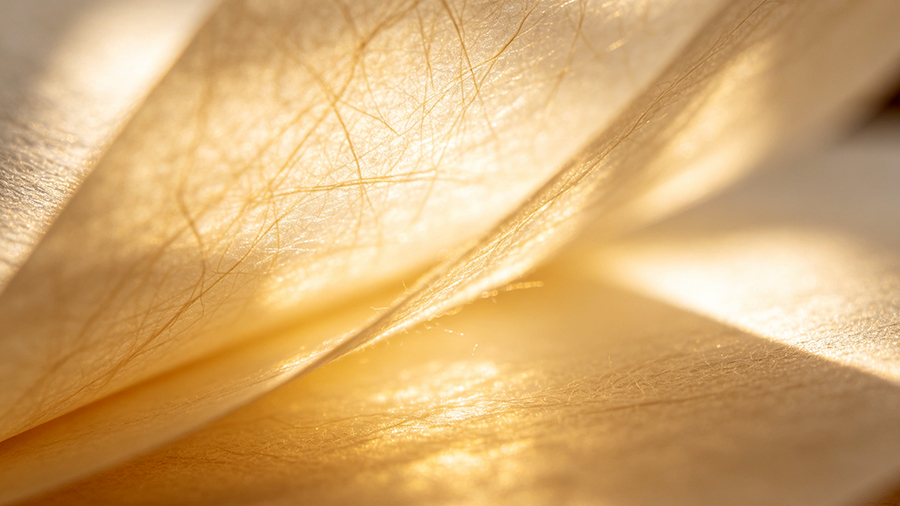
Hold a good sheet in front of a warm LED and the light does not simply pass through it. The fibers soften the glow. A surface that looked almost plain on the table begins to show small changes in density and texture.
Dongba paper from Yunnan has a different character. It belongs to the paper tradition of the Naxi people and is closely associated with handwritten Dongba manuscripts. The sheets I have handled are thicker and more visibly fibrous than Xuan paper. Put two panels side by side and they do not behave like factory-made copies. One may show a heavier patch of fiber; another may let through a little more light.
I used to see that as inconsistency.
Now I see it as the paper telling the truth about how it was made.
I have also worked with papers made from long bark fibers, including mulberry-based papers. Similar plants are used in several Asian papermaking traditions, but the papers are not interchangeable. Chinese mulberry-bark papers, Japanese washi and Korean hanji each come from their own places and methods. What they often share is a long, strong fiber that can make a sheet feel surprisingly soft and tough at the same time.
That strength matters when you are shaping paper around a lamp. The softness matters when the lamp is on.
Light With a Grain
A smooth, machine-made shade gives you even, predictable light. There is nothing wrong with that. But it can feel anonymous.
Handmade paper behaves differently. Some areas are slightly thicker than others. Fibres cross, gather and thin out. You may not notice any of this until the lamp is turned on. Then the shade gains depth. The light has a grain to it.
The effect is quiet. Nobody walks into the room and gasps. Usually they just sit down and say, “It feels different in here.”
That is the part I care about.
I began noticing it when friends came over. Under the overhead light, the room felt like a place where we should stay alert and keep doing things. When I turned that light off and left one paper lamp on near where we were sitting, the room settled down.
So did we.
People reached for their phones less quickly. Conversations lasted longer. I’m not claiming the lamp caused all of that, and I’m definitely not a wellness expert. A paper lamp cannot fix your sleep, your stress or your relationship with your phone.
It can, however, change the mood of a corner.
Sometimes that is enough to change what you do next.
A Corner Is Enough
You do not need to redesign your home or dedicate an entire room to being offline.
Find one corner. Give it a chair or a floor cushion, a small table and a low lamp. That is enough.
For the light source, I prefer a warm LED around 2700K. That number describes the color appearance of the light, not its brightness. Around 2700K usually looks warm and familiar in a home, while higher color temperatures tend to look cooler and are common in workspaces.
Brightness matters too. A warm lamp can still feel harsh if it is too bright or aimed straight at your eyes. Use enough light to see comfortably, then stop.
Keep the lamp near sitting height rather than relying on a strong ceiling light. I find that light coming from beside me feels calmer than light pouring down from above. That is a personal preference, not a medical rule, but it is easy to test in your own room.
Then sit there for twenty minutes.
Put the phone somewhere you cannot reach without standing up. Not because you are “doing a detox.” That makes it sound like homework. Just give yourself twenty minutes without being asked to respond to anything.
Watch what the light does on the wall. Notice the fibers in the shade. See whether the room feels different.
Maybe it will. Maybe it won’t. Either answer is useful.
Paper Makes You Handle Things Differently
Making lamps from handmade paper also changed the way I think about materials.
Traditional paper is slow. Bark has to be prepared. Fibres are soaked, cooked or fermented depending on the paper, then beaten into pulp, formed into sheets, pressed and dried. The exact process varies from one tradition and workshop to another. It takes knowledge, water, physical work and patience.
Once you understand that, you stop treating a sheet as disposable.
I used to worry when one lamp came out slightly different from the next. Now that difference is part of the reason I make them. The fibers do not line up on command. The glow is never perfectly uniform. A handmade shade carries evidence of hands other than mine.
The lamps change with use too. Paper can soften and shift in color as it ages, especially with light and changes in the room. That is not something to hide. One of my older lamps has become warmer in tone over the years, and I like it more now than when it was new.
People often put every plant-based material under the word “sustainable.” I try not to do that. Handmade paper is not automatically good for the environment, just as factory-made paper is not automatically bad. The source of the fiber, the chemicals used, the water treatment, transport and the working life of the finished object all matter.
What I can say is simpler: when I know where a paper came from and how much work went into it, I waste less of it. I make the lamp carefully. I keep it longer. I hope the person who takes it home will do the same.
Why I Keep Making Them
Paper Life is my attempt to share the feeling I found in that first sheet of paper.
I use traditional papers, especially papers from China, because they are the materials I know best. Every lamp comes out a little different because every sheet is a little different. I used to apologize for that. I don’t anymore.
A paper lamp will not make you put your phone down. No object can make that decision for you.
But after you put the phone down, it can give you somewhere gentler to look.
It can turn an unused corner into a place that feels like it is on your side.
The paper still feels warm when I pick it up. I notice it every time.
That is why I keep making these lamps.