
A paper that survived the desert nearly disappeared at home
In Hotan, on the southern edge of the Taklamakan Desert, people have made paper from mulberry bark for at least a thousand years.
We know this because old documents survived. The Hotan Museum holds Tang-period texts written on mulberry paper, along with later manuscripts in several languages. Dry desert conditions helped preserve them, but the material did its share of the work.
That is the surprising part. A sheet made from bark, water and sunlight lasted for centuries. The craft that made it almost did not.
Paper for ordinary life
Mulberry paper was once an everyday material in southern and eastern Xinjiang. People wrote and printed on it, wrapped tea and medicine in it, lined hats with it and used it in clothing and footwear. In the early twentieth century, it was even used for local banknotes.
It was useful paper, not a luxury product.
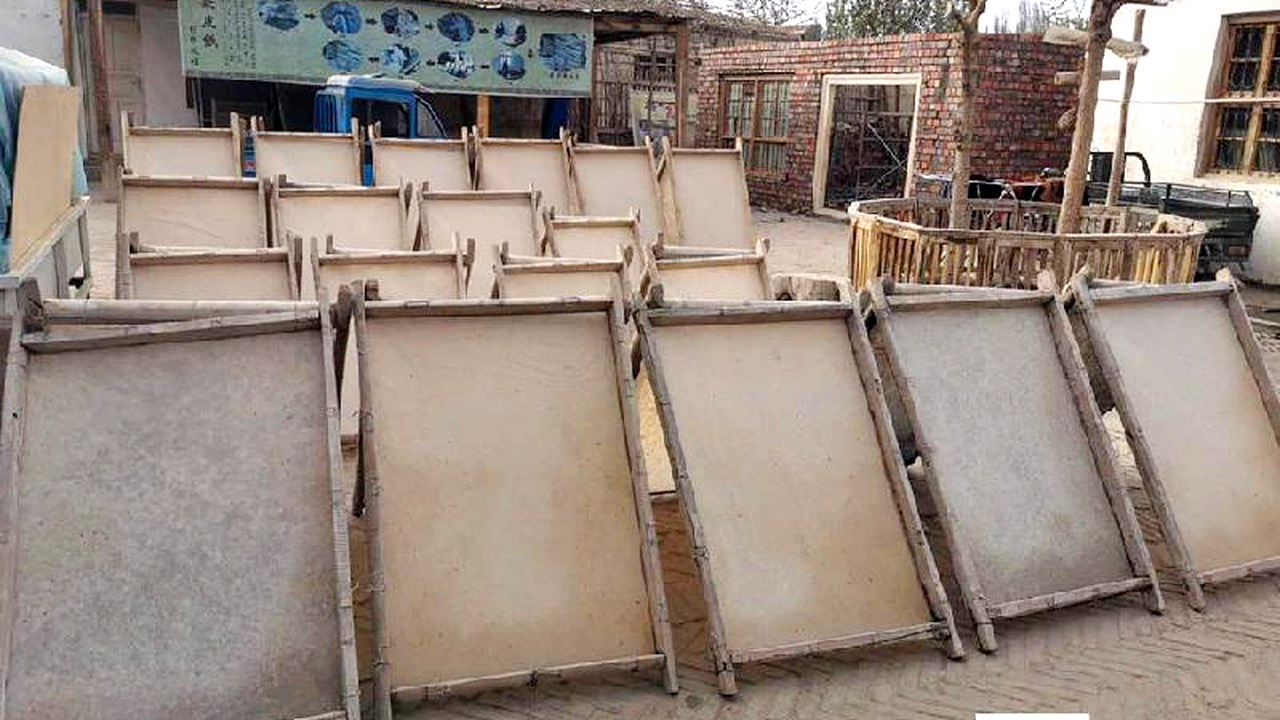
The inner bark of young mulberry branches provides the fiber. Makers remove the outer bark, soak and boil the inner layer, beat it into pulp, let it ferment, filter it and spread it across a mould. The wet sheet dries in the sun. Official records describe nine main stages, all done by hand.
The finished paper is thin, slightly rough and easy to recognize once you have handled it. Hold it to the light and the fibers remain visible. It looks closer to cloth than to the smooth white paper sold in a stationery shop.
I make paper lamps, so that uneven surface is the part I notice first. It changes how light passes through the sheet. Some areas glow more warmly than others, and the fibers never quite disappear.
Then people stopped needing it
Mulberry paper began to lose its place in daily life when factory-made paper became cheaper and easier to buy. According to China's national intangible cultural heritage records, it had already dropped out of printing and formal writing by 1950. By the 1980s, it had almost completely disappeared from everyday use.
The reason was ordinary: the market had gone.
Papermakers changed jobs. Their children saw little reason to learn a slow process with few buyers. A craft that had passed through families for generations was reduced to a small number of older makers.
This part of the story is easy to romanticize. It is tempting to picture one heroic craftsman saving everything alone. The official record is less tidy. Families in different parts of Xinjiang kept fragments of the knowledge, and individual makers continued working when there was little money in it. The craft survived because several people refused to let their part disappear.
In 2006, Uyghur mulberry paper making was included in the first national list of intangible cultural heritage in China. That recognition did not send the paper back into every home. It did give local makers more room to teach, demonstrate and sell their work.
What survival looks like now
Mulberry paper is still made in villages around Moyu County. Workshops demonstrate the process for visitors, and makers now use the sheets for calligraphy, painting and small cultural products as well as traditional purposes.
This is not the same world the paper came from. It no longer needs to serve as the region's everyday writing and wrapping material. Its future depends on finding new uses without turning the craft into a performance emptied of skill.
That balance is hard.
A handmade sheet costs more than factory paper. It takes time, good weather and practiced hands. If buyers care only about the story, the paper becomes a souvenir. If they care only about a perfectly even surface, they may as well buy something made by machine.
The value is in the material itself: the long fibers, the visible texture and the slight differences from one sheet to the next.
The paper does not need a legend
Mulberry paper is often called a "living fossil." I understand why, but the phrase makes the craft sound frozen.
It is not frozen. People are still making it, adjusting how they sell it and deciding what it can become. Some of the old uses have disappeared. New ones are still being tested.
For someone who works with paper, that is more interesting than a neat rescue story. The craft did not return to the life it had a century ago. It found a smaller, less certain life in the present.
The old manuscripts prove that the material can last. They cannot guarantee that anyone will keep making it.
If you want to see what survived, search for Uyghur mulberry paper from Hotan or Moyu County. Look at a real sheet, especially one held against the light. The fibers tell the story better than the label does.